

 j7uy5 |
When the bees start buzzing around, it is past time to get started with the garden. The photo above shows a bee that is finding something of interest on a peach tree.
Tomato seedlings are doing well. Notice that two of them are blooming already. They are growing in peat pots coconut coir pots. We use an Ikea serving tray to take them outdoors in the daytime, to harden off. It is still too early to put them in the ground, but we have raised beds ready for them. Today the high temp around here is supposed to get to 81F, but there are still freezing temps anticipated at night in the…
j7uy5 |
href="http://www.flickr.com/photos/jyaroch/6705513045/"
title="IMG_2804.JPG by Joseph j7uy5, on Flickr">
src="http://farm8.staticflickr.com/7015/6705513045_23cc0c3390.jpg"
alt="IMG_2804.JPG" align="left" border="1" height="188" hspace="3"
vspace="3" width="250">This is one of those medical diagnostic
mystery stories. Except, as you can tell from the picture, it is
not about diagnosis of a human. Rather, it is about diagnosis of
a machine. The photo shows the inside view of a Fellowes SB-87Cs
paper shredder. I bought this several years ago to shred several
boxes…
j7uy5 |
Last February, we had a very unusual hard freeze. It killed a lot of plants.
The prior year, I had gotten an agave from a local nursery. It was a nice specimen, about 12 inches wide; it cost $25. In the freeze, it died. So I removed all the dead matter above ground. In the springtime, I watered it sparingly. After a couple of months, there was no visible growth.
One weekend, I went and bought a plant to replace it. The new plant is a Dasylirion wheeleri, aka sotol, or desert spoon. These things grow in the mountains, where it actually snows sometimes. Ought to be able to tolerate…
j7uy5 |
The good folks at Shrink Rap are conducting a survey about attitudes toward psychiatry. I would appreciate it is some of you would participate.
j7uy5 |
Agave
lechuguilla,
commonly called lechuguilla or shin dagger, is a type of agave that
grows in northern Mexico and southwestern USA. It is highly
tolerant of drought and alkaline soil; it is somewhat tolerant of
cold. Each plant blossoms exactly once, then the entire plant
dies. I have read that if you cut off the stalk when the plant
starts to blossom, it won't die. Instead, it will form little
pups (offsets) from the roots.
We had a hard freeze in February that killed most of the century
plants, all of the oleander, and severely damaged many other
plants. The…
j7uy5 |
A little less than one year ago, the major environmental news pertained
to the Deepwater Horizon oil spill. From Wikipedia:
The Deepwater Horizon oil spill (also referred to as the BP
oil spill, the Gulf of Mexico oil spill, the BP oil disaster or the
Macondo blowout)[4][5][6] is an oil spill in the Gulf of Mexico which
flowed for three months in 2010. The impact of the spill continues even
after the well has been capped. It is the largest accidental marine oil
spill in the history of the petroleum industry.[7][8][9] The spill
stemmed from a sea-floor oil gusher that resulted from the…
j7uy5 |
After the 2010 elections in the USA, headlines proclaimed, "
href="http://www.theolympian.com/2011/01/08/1498746/with-new-republican-majority-let.html">With
new Republican majority, let the investigations begin," and "
href="http://www.mmail.com.my/content/59595-new-republican-majority-congress-promises-tough-ride-obama">New
Republican majority Congress promises a tough ride for Obama."
One of the big targets for investigations:
href="http://www.thegwpf.org/science-news/2508-a-climate-skeptic-with-a-bully-pulpit-in-virginia-finds-an-ear-in-congress.html">climate
science.…
j7uy5 |
This is a
href="http://www.flickr.com/photos/jschroe/2213298226/in/photostream/">photo
of a blonde zebra, or
href="http://www.wildwatch.com/sightings/is-it-an-albino-zebra">albino
zebra.
title="Blonde Zebra 2 by jschroe, on Flickr">
src="http://farm3.static.flickr.com/2129/2213298226_9b843081fa.jpg"
alt="Blonde Zebra 2" height="375" width="500">
style="border-collapse: separate; color: rgb(0, 0, 0); font-family: 'Times New Roman'; font-style: normal; font-variant: normal; font-weight: normal; letter-spacing: normal; line-height: normal; orphans: 2; text-indent: 0px; text-…
j7uy5 |
Ok, here's an idea. The Dervaes family have decide to make the phrase "urban homestead" a registered trademark (1 2 3 4 5; also see the EFF post). Presumably, they are doing this to make money. They have gone so far as to send DMCA takedown notices to other persons...persons who, presumably, thought they all were colleagues of some sort. I guess not.
So, if it is possible to make money off of something that is rather commonplace (About 179,000 results on Google) on the Internet, I've got an idea that is even better. I am going to trademark Insufferable Arrogance®. Not the phrase, mind…
j7uy5 |
This is decidedly ironic:
Rolling outages affect most chilly Texans all day
By ANGELA K. BROWN Associated Press
FORT WORTH, Texas -- A high power demand in the wake of a massive ice storm caused rolling outages for more than eight hours Wednesday across most of Texas, resulting in signal-less intersections, coffee houses with no morning java and some people stuck in elevators.
The temporary outages started about 5:30 a.m. and ended in the afternoon, but "there is a strong possibility that they will be required again this evening or tomorrow, depending on how quickly the disabled generation…
j7uy5 |
Every clinician knows that careful observation is the foundation for all knowledge. Reading the account of how Nabokov correctly anticipated the outcome of DNA analysis of butterfly taxonomy, using only his acute powers of observation, I am reminded of historical accounts of physicians who could estimate a person's hematocrit value just by looking at the palm of a patient's hand.
One of the problems, with the rise of the machine in medicine, is that these observational talents are being lost.
 j7uy5 |
From Media Matters:
It is difficult to understand how so many errors could be crammed into
one simple chart, merely by accident. It is even harder to
understand how the artist could end up with a straight line, after
incorporating numerous errors, unless it was an done with the intention
of being misleading.
First, (problem #1) the Y-axis does not start at zero. That is a
fairly
common error. Sometimes it is done innocently, and a notice is
posted. For example, "Y-axis does not start at zero, to better
show the change," or something like that. OK. That's…
j7uy5 |
Sharron Angle
has said some pretty obtuse things before, but for the most part, I've
resisted the temptation to comment. But
href="http://bigthink.com/ideas/20647">this one is a gem:
The 16-page flier, available
href="http://tpmdc.talkingpointsmemo.com/2010/06/sharron-angles-independent-american-party-anti-gay-flier.php">at
TPMM, accuses gay people (aka "sodomites", "perverts") of
everything from child molestation, to serial murder, to debasing
rodeos, to contaminating the water supply by exuding HIV. Blood libel,
or urine libel, as the case may be.
I don't care about the…
 j7uy5 |
Clearly, this man is a candidate for the
href="http://www.darwinawards.com/">Darwin Award. K. Wayne
McLeod has been charged -- posthumously -- with running a Ponzi scheme
that victimized an estimated 260 law enforcement agents.
He deliberately solicited hundreds of people, all of whom have guns,
all of whom know how to use their guns, and all of whom have access to
information resources that can be used to locate other people. He
then did something that was guaranteed to piss every single one of them
off.
The outcome is not particularly surprising.
href="http…
j7uy5 |
(From five years ago!)
There is a restaurant called Pelagos. The name means "from
the sea," in Greek. It is underground, but has a patio open
to the sky. A staircase leads from the sidewalk to the
subterranean patio. The is a metal fence along the sidewalk.
On the patio, there are tables with umbrellas.
Large windows provide a view of the patio, from inside the
restaurant. Looking out, a person might be fascinated by the
geometrical shapes formed by the window frames, the the tables, the
steps, and the fence; that person might also be happy to…
 j7uy5 |
This one is useful for very few persons. The story is this: I wanted to get one of those mats that goes under a treadmill, to protect the floor. So I went to Sears, where I got the treadmill, because I had seen an ad for the mat. Thirty dollars is what they wanted. Seemed overpriced. But that is what they want. Being a tad compulsive, I measured the treadmill's footprint before I left. The mat would have to be 40 inches wide and 72 inches long.
At the store, the mats -- all with the same brand name as the treadmill -- were all 36 inches wide. Would not do. So I get one off the shelf…
 j7uy5 |
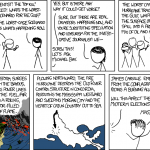
XKCD usually is pretty good; this one, however, is a brillant commentary on science journalism. People forget that once an event has happened, the probability of that event is exactly 1, and the probability of all other outcomes is exactly zero. (Click image for full-size view.)
(Source page.)
j7uy5 |
href="http://scienceblogs.com/corpuscallosum/2008/05/repetitive_transcranial_magnet.php">Repetitive
transcranial magnetic stimulation (rTMS) is a treatment for
major depression. It was approved (
href="http://www.accessdata.fda.gov/cdrh_docs/pdf8/K083538.pdf">PDF)
by the FDA in 2008. However, it has remained somewhat of a niche
treatment. Some providers remain
href="http://www.shockmd.com/2008/10/17/transcranial-magnetic-stimulation-gains-approval-of-the-fda-for-depression/">unimpressed
by studies of efficacy. One problem is that most of the studies…
j7uy5 |
I just noticed this: the average workweek in the USA has declined to
34.1 hours (see
the BLS report: Employment Situation Summary). Last
year, the average television viewing time increased to
href="http://www.cnn.com/2009/SHOWBIZ/TV/02/24/us.video.nielsen/">151
hours per month, or 5.03 hours per day in a 30-day month, which
comes out to 35.23 hours per week. We now spend more
time watching TV than we spend working.
j7uy5 |
National Geographic
href="http://news.nationalgeographic.com/news/2010/04/100421-new-fungus-cryptococcus-gattii-deadly-health-science/">reports:
A new strain of hypervirulent, deadly Cryptococcus gattii
fungus has been discovered in the United States, a new study says.
The outbreak has already killed six people in Oregon, and it will
likely creep into northern California and possibly farther, experts
say...
Cryptococcus infections in humans are hardly new. And so
far, the public health impact of the outbreak has been very low
(understanding, of course, that the personal impact…