

Pseudoscience is effective. If it weren't, people wouldn't generate so much of it to try to justify opinions not supported by the bulk of the evidence. It's effective because people trust science as a method of understanding the world, and ideological actors want that trust conferred to their opinions. They want their opinions to carry that authority, so they imitate science to try to steal some of that legitimacy for themselves. However, science is not flattered by this behavior, it is undermined and diminished.
The Damore Manifesto (PDF with hyperlinks) or "Google anti-diversity memo…

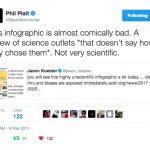
The American Council on Science and Health recently got some exposure on twitter, then a little too much exposure, after publishing this highly problematic (and hysterically bad) op-ed/infographic on twitter and on their site.
This opinion piece, presented as if there is some method or objective analysis, purports to show which are the best and worst science news sites. But this immediately started to fall apart on the most cursory inspection. First of all, notice the x-axis, it's clearly some kind of subjective assessment, and it immediately fails to be credible as the New York Times is…
Inevitably, with the announcement of The March for Science on Earth Day, April 22nd of this year, come the inevitable naysayers decrying the politicization of science. Astroturf groups such as ACSH (diversity excludes white dudes and scientists from industry!), have of course decried the effort as a liberal conspiracy, but I was sad to see even the New York Times found a scientist to rain on our parade.
A march by scientists, while well intentioned, will serve only to trivialize and politicize the science we care so much about, turn scientists into another group caught up in the culture…
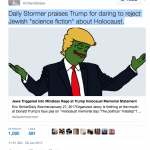
The White House in its statement on Holocaust Remembrance Day engaged in Holocaust denial. Then they doubled down on the action and via Reince Priebus on Meet the Press expressed no regret about the wording which had no mention of the Jews in their supposed "remembrance". This has been criticized from both ends of the political spectrum, from John Podhoretz in Commentary Magazine (a Reagan speechwriter and conservative columnist) to Tim Kaine characterizing it, correctly, as Holocaust denial.
You may ask, why is this denial? Is this hyperbole? You may even find the administration excuse…
Amanda Marcotte, who I've enjoyed reading since her days at Pandagon, was curious about what having a CT president might mean. For some crazy reason, she thought she should ask me about it. Briefly, I tried to summarize the patterns of thought conspiracy theorists engage in, their willingness to accept any belief if confirmatory of their guiding ideology, and their tendency to project their own darkest behaviors onto others. Overall, I thought she provided a great summary of the problem. My only critique would be it's not all doom and gloom.
One thing we talked about that didn't make it…
I've not written about this election believing the flaws of the Republican candidate were pretty obvious; further litigating his failures as a candidate is now moot, he is now the president-elect of the United States. However, it is worth discussing what this administration will now bring given what we know about how conspiracy theorists behave and I believe our experience with conspiracy theorists and denialists gives some insight into what we can expect from a conspiracy theorist (CT) politician. There are some questions that may be answered and may help the scientific community develop…
John Cook, of Skeptical Science fame, has created an online course through the University of Queensland and edX, on denialism and climate change. Easy to access and free to take, I found it simple to join from their facebook page, and if you don't want to join you can still see the lectures from their Youtube channel.
Having gone through the materials so far I have to say Cook nails it. His graphic depicting the 5 tactics is very clear and easy to understand.
Also I think he has done a great job of making clear that the problem isn't one of education, facts or knowledge. The problem is…
Bill Maher did it again last night, doubling down on his anti-vax nonsense claiming the real problem is we haven't done a controlled population-based trial on vaccination vs non-vaccination. Sadly, I don't have a clip, but I have to say this time at least I was gratified that his panel wasn't composed of complete morons and they actually challenged him on some of his nonsense. This is actually a classic impossible expectations denialist argument, he essentially proposes an experiment that would be wildly expensive, impossible to perform, and highly unethical. Worse, it still is internally…
It is amazing how powerful a free lunch is. And the data are real, that people tend to favor those who do nice things for them. That is why, despite new rules about the amount drug companies can give to doctors, or all the rules on disclosure, the pharma reps are always going to push the boundary to try to gain any advantage because it results in real world financial benefits to pharmaceutical companies.
Leave it to John Oliver to nail this. Reps are pervasive. They are influential. Their influence comes not necessarily from the right impulses of science and data, but from attractiveness…
I'm glad to see clips like this from the daily show appropriately mocking the deluded, and supposedly "educated" types that don't vaccinate.
But have we forgotten this episode from 2005 when he allowed RFK Jr to basically spout his nonsense about vaccines without challenge?
It's good and fine for Stewart to mock these people now. But he seems to forget he helped contribute to this problem. Is anyone aware of an apology from Stewart for allowing this crackpot to use his megaphone? Isn't it precisely members of the media like him that are to blame for failing to vet the claims made…
My favorite news story of the week, herbal supplements don't contain anything at all apparently. Why should we be surprised that big placebo is selling placebos?
The authorities said they had conducted tests on top-selling store brands of herbal supplements at four national retailers — GNC, Target, Walgreens and Walmart — and found that four out of five of the products did not contain any of the herbs on their labels. The tests showed that pills labeled medicinal herbs often contained little more than cheap fillers like powdered rice, asparagus and houseplants, and in some cases substances…
This week's Realtime with Bill Maher was just about the most perfect example I've seen yet that maybe reality doesn't have a liberal bias. Due to the measles outbreak becoming a hot-button issue, and the realization that his smoldering anti-vaccine denialism would not go over well, our weekly debate host decided to instead unleash all of his other incredibly stupid, unscientific beliefs about medicine.
This was astonishing. And because his panel, as usual, is composed largely of political writers and journalists, there was no one to provide a sound scientific counterpoint to the craziness…
The latest entry in the "OMG really?" wars is brought to us by the libertarians, who, using the example of the brutal oppression of hand washing regulations, make total fools of themselves.
Speaking during a question-and-answer session at the Bipartisan Policy Center on Monday, Tillis related a story from his tenure in the North Carolina legislature to help explain his overarching philosophy on the finer points of hand-washing.
“I was having this discussion with someone, and we were at a Starbucks in my district, and we were talking about certain regulations where I felt like maybe you…
I've been following the fall-out of the Rolling Stone article a Rape on Campus as well as their evolving preamble to the story, first expressing doubt, then seemingly dismissing Jackie's account, now falling somewhere in-between with assertions that they have supporting evidence that Jackie was assaulted that night, but no idea of the details. I got a visit from some overly gleeful commenters that seemed to rejoice that the story is a hoax, and Jackie a liar, but it's clear this situation is more complex. The story contained more than Jackie's experience, and the focus of our original…
The GMO debate hosted by Intelligent Squared was excellent and informative. I admit I learned things from listening and that's always a bonus, but it's worth watching to see the "respectable" arguments against GMO posed and dealt with very effectively by the pro-side in this debate. Spoiler alert, the pro-GMO side spanked the anti-GMO, going from 30% pre-debate in support of GMO (~30% against and 38% undecided) to 60% in support of GMO post-debate with anti-GMO only climbing 1% to 31. While voting on points of science and data is largely irrelevant, science is not democratic, it is reassuring…
We should have predicted this when we discussed the UVa Rape story in Rolling Stone last week, it was just a matter of time before people would start suggesting the central figure in the story, Jackie, might be fabricating. I would be surprised if this response did not occur, because sadly it is so typical. What I'm surprised by is that the New York Times, is credulously repeating this smear led by Richard Bradley, and Jonah Goldberg of all people.
Still, some journalists have raised questions about the story. Richard Bradley, who as an editor at George magazine was duped by the former New…
The Rolling Stone article, "A Rape on Campus" should be a must read for every one who attends college, plans to attend college, or has children or loved ones on a college campus, especially one with a significant fraternity presence. UVa is my alma mater for two of my degrees, but this story reminded me more of my experience as an undergraduate at Bucknell University, a small, private, liberal arts university in Pennsylvania which is also dominated by fraternity culture. My experience there with sexual assault was not as a victim, but as a member of one of the pseudo-legal sexual assault…

Never thought I would write this: Maastricht University is organizing a conference on the intersection of denialism and human rights. Here is a link to the conference description and the call for papers can be downloaded here.
I'm reading Jeffrey Kacirk's delightful Forgotten English, which includes this anecdote concerning boanthropy, a condition where a person believes himself to be a cow or ox:
In 1792, Edward Jenner successfully developed a vaccine for smallpox by injecting a boy with closely related cowpox germs. He did this despite his medical critics' attempts to scuttle his project by circulating boanthropy scare-stores. The critics alleged that those inoculated would develop bovine appetites, make cowlike sounds, and go about on four legs butting people with their horns...
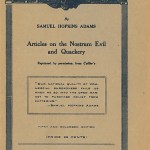
As part of related research into consumer protection, I recently scanned in a copy of Samuel Hopkins Adams' seminal articles on the patent medicine industry. These articles, which appeared in Collier's magazine starting in 1905, helped build the record for the 1906 Pure Food and Drugs Act, and for amendments to that law in 1912.
There are fourteen articles in the series and in them you will see how little has changed in the world of quackery. Adams focused much of his attention on the relationship between publishers and quacks, a problem that exists to this day (publishers are one of the most…