


You are currently at the old, defunct version of Tet Zoo. To see new stuff (from July 2011 to present), click here. See you there.
On January 23rd 2007, Tet Zoo ver 2 - the ScienceBlogs version of Tetrapod Zoology - graced the intertoobz for the first time. There was rapturous applause, swooning, the delight of millions. Looking back at it now, that very first ver 2 post is rather odd. It's on the blood-feeding behaviour of oxpeckers (Buphagus) and it only really mentions the move to ScienceBlogs in passing, as if it wasn't a big deal.
In reality, being invited in to join the ScienceBlogs collective was a big deal, and were I to go back in time and re-live the writing of that particular article I'd do much more of a "…

So sorry for the very short notice. The following airs here in the UK tonight (Thursday 30th June 2011), Channel 4. I look forward to it.
For the Tet Zoo articles on ING and related issues, see...
Inside Nature's Giants: a major television event worthy of praise and accolade. Part I!
Inside Nature's Giants part II: whale guts and hindlimbs ahoy
Enough mammals for the time being: crocodiles on Inside Nature's Giants (part III)
Inside Nature's Giants part IV: the incredible anatomy of the giraffe
Inside Nature's Giants, series 2: does Carcharodon bite?
Monster pythons of the Everglades:…
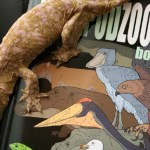
If you didn't know, I've been away. The last four articles that have appeared here were all scheduled to publish in my absence. I've been in Romania and Hungary where I had a great time - saw lots of neat animals (fossil and living) and hung out with some neat people. I'll talk about some of this stuff in due course. For now, here's a really nice picture, kindly provided by artist-animator Ethan Kocak.
Ethan keeps and breeds geckos and, as you can see from this photo of one of Ethan's New Caledonian giant geckos Rhacodactylus leachianus henkeli, it seems that these lizards are big fans of at…
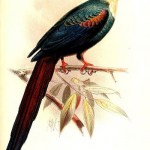
Yet more from that book project (see the owl article for the back-story, and the hornbill article for another of the book's sections).
Hornbills, hoopoes and woodhoopoes are all similar in appearance and have been classified together in a group termed Bucerotes. Vague similarities with other long-billed, forest-dwelling birds (like woodpeckers, long-billed cuckoos and such passerines as tree-creepers) meant that early ornithologists were often confused about the affinities of these birds. By the late 1800s, however, most had realised that all three were close relatives, and that they were…
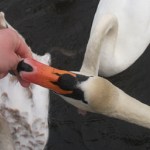
Suppose you're interested in the anatomy and biology of ground hornbills. Now suppose that you get the chance to make physical contact with one of these awesome birds. Here, at last, is the opportunity to get bitten!! Surely you've always wanted to know what it feels like when a ground hornbill bites you. No? Ok, maybe it's just me. Anyway, the opportunity to get bitten by a ground hornbill presented itself to me a few weeks ago, so who was I to miss out?
As I can now confirm from personal experience, it turns out that ground hornbills don't bite hard enough to hurt. My impression is that…
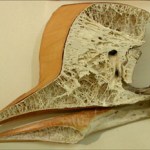
More from the bird book. For the back-story, see the previous owls article.
Hornbills are among the most distinctive and spectacular of Old World tropical birds. Often flaunting bright colours and sometimes reaching huge sizes (the largest species have wingspans of 1.8 m), they're well known for their enormous, curved bills and large bony crests. [Image above shows Great Indian hornbill skeleton Buceros bicornis (l) and male Wreathed hornbill Rhyticeros undulatus (r) (by Blijdorp, from wikipedia). Hornbills like the Great Indian hornbill are forest-dwelling omnivores that eat fruit as well…
There's something they don't tell you about freelance writing. It's about all the fails: the many, many projects that get pitched, worked on and made into proper presentations that then get sent to book fairs, interested companies and so on, but ultimately explode on the launch pad, or die a slow, lingering death. I don't know if it's that I'm especially unlucky, or if it's that I've pitched an unusually high number of books, or if it's that I've genuinely worked on a high number of projects that were never destined to succeed but, whatever, I've now worked on loads of failed book projects.…
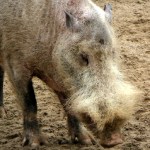
One of the most remarkable pigs has to be the Bornean bearded pig Sus barbatus, one of two currently recognised bearded pig species. The other is the much smaller, shorter-faced Palawan bearded pig S. ahoenobarbus of the Philippines: genetic work suggests that S. ahoenobarbus is not a close relative of S. barbatus, but actually closer to the Celebes warty pig S. celebensis and other Philippines pigs (Lucchini et al. 2005). S. barbatus occurs on Sumatra, Bangka, the Riau archipelago and the Malay Peninsula as well as Borneo. There are two subspecies: S. b. barbatus has long cheek beards…
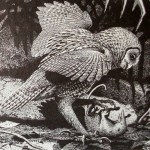
Here's something you don't see very often...
This illustration (by Peter Trusler) shows the large Pleistocene Cuban owl Ornimegalonyx oteroi battling with a solenodon. Ornimegalonyx has been mentioned here a few times before (use the search bar), but nothing substantive, sorry. Most sources mention O. oteroi as if it's the only named species of Ornimegalonyx. Actually, Arredondo (1982) named three additional ones: O. minor, O. gigas and O. acevedoi. And, by the way, the Ornimegalonyx owls weren't the only big owls on Pleistocene Cuba - there was also a particularly big eagle owl (Bubo…
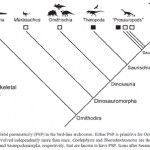
One of the strangest Mesozoic dinosaurs ever described has to be the African iguanodontian Lurdusaurus arenatus, named in 1999 for remains from the Lower Cretaceous Elrhaz Formation of Gadoufaoua, Niger (Taquet & Russell 1999). The Elrhaz Formation has also yielded the sail-backed iguanodontian Ouranosaurus, the rebbachisaurid sauropod Nigersaurus, the theropods Kryptops, Suchomimus and Eocarcharia, and the crocodilians Anatosuchus and Sarcosuchus. [Adjacent Lurdusaurus image by Luis Rey, used with permission.]
As is well known among dinosaur researchers, Lurdusaurus was first…
On July 12th 2011 a very interesting thing is happening - interesting, that is, if you're interested in the academic evaluation of cryptozoological data. ZSL (the Zoological Society of London) is hosting the meeting 'Cryptozoology: science or pseudoscience?'. Speakers are Charles Paxton, Michael Woodley and myself. Henry Gee is acting as chair.
Given that one of the things we hope to address is whether cryptozoology - whatever that term might mean - should be considered a valid branch of zoological science, this meeting shouldn't be taken as evidence that cryptozoology has finally "come in…
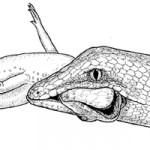
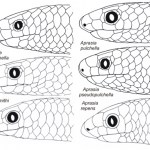
In the previous article I provided brief reviews of all currently recognised pygopodid 'genera'*. Except one. I've left this one until last, largely because it's the most spectacular (up to 75 cm in total length) and (arguably) most fascinating pygopodid. We've seen throughout this series of articles that pygopodids are convergent with certain snake groups, and may in fact have been so successful at filling up ecological niches occupied elsewhere by colubroid snakes that they effectively prevented such snakes from evolving: you can imagine this as the 'pygopodids got there first' hypothesis…
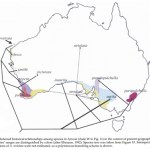
I really want to get these pygopodid articles finished. Actually, I really want to get the whole gekkotan series finished: the end is in sight and I know I'll get there eventually. In the previous articles on pygopodids (part of the long-running series on gekkotan lizards: see links below), we looked at pygopodid diversity and biology in general, and also at the phylogeny and evolutionary history of these fascinating, snake-like gekkotans. This time round, we look in more detail at the various different pygopodid taxa - not on a species-by-species basis (alas), but according to the units we…
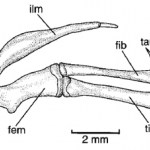
The previous article - part of my now lengthy series on gekkotan squamates (see links below) - provided an introduction to the neat and fascinating near-limbless Australasian gekkotans known as the pygopodids. Disclaimer: the group being discussed here is 'Pygopodidae of tradition', not Pygopodidae as currently formulated. More on this matter later.
One topic that I didn't explore fully in the previous article is pygopodid diversity. These reptiles aren't all samey little generalists; species within the group practise several different lifestyles and foraging behaviours, and the amount of…
One of my shortish-term goals at Tet Zoo has been to complete the series on gekkotan lizards I started in April 2010 (see below for links to previous parts). We continue with that series here, and this time round we're going to look at what should definitely be regarded as the weirdest of gekkotans: the near-limbless pygopodids, pygopods or flap-footed lizards, all of which inhabit Australia and New Guinea (and at least some of the surrounding islands). Because there's a lot to say about them, the article you're reading is the first of three. [Excellent paintings below by Alan Male, from…
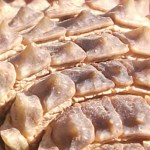
Once again I'm in that frustrating position so beloved of bloggers: where life and work just doesn't let you fritter away all those 'spare' hours preparing lengthy blog articles. In the mean time, here's one of those 'mystery pictures' to identify. What is it? Genus will do (I know the species, but that's because I have special data not available from this image). [UPDATE: no more guessing please. Answer below, comment # 31.]
While I'm here I may as well mention a few things I won't get to blog about.
Just did the trawling-the-journals thing. New items of much interest include the new long-…
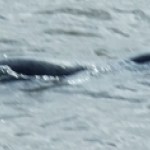
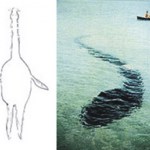
On May 24th 2011, photographer Mark Harrison took a few photos of the large marine creature he saw off the Wirral Peninsula, near Liverpool (UK). Harrison initially thought that the animal might be a seal, but then decided to put the photos online as a sort of joke. Several newspapers then ran the photos as depicting a "sea monster" - dubbed the "Mersey monster" - that "baffles marine experts". Most of the coverage has appeared in the Liverpool Echo. So - OMG! - a new sea monster photographed!! Can we ever solve this most mysterious monster mystery??!? Well, duh.
The Liverpool Echo…
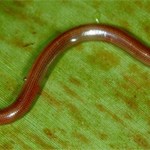
Dibamids are a weird and very neat group of fossorial, near-limbless squamates that I've long planned to cover at Tet Zoo. Little is known about them and how they might relate to other squamates has long been the subject of debate (they might be close to amphisbaenians, but links with gekkotans, skinks and snakes have all been suggested in the past). I'm going to avoid saying much about them here: I just want to point to the fact that a newly named species - Dibamus dalaiensis Neang et al., 2011 [shown here; image Thy Neang/Flora & Fauna International] - extends their distribution to…
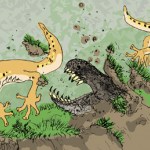
When unable to find time to do anything else, resort to posting Squamozoic sneak-peeks (previous example here)...
This scene - 'Riverbank ambush' - features a giant macro-predatory amphisbaenian and some surprised gekkotans. Colouring by Tim Morris. Feel free to discuss among yourself. Kinda busy right now...