
In just a few days, my good friend and fellow Zooillogix blogger, Julia, will leave the safety of Chicago for the violent, pineapple-strewn streets of Honolulu for a new job. Here are some things you should know about Julia: #1 - She is the best kickball player in the Midwest. #2 - She has a margay tattoo across most of her torso and Ernst Haeckel tattoos on her arms. #3 - Despite her PhD meets Sons of Anarchy bodywork, she is one of the sweetest people I know.
Among other activities, I have greatly appreciated her company for beer drinking, music listening, encasing wild mushrooms in clear…

New YouTube research definitively proves that turtle society is highly altruistic and that Disney's heretofore refusal to make a movie about them is racism, pure and simple.
 jchosy |
We here at Zooillogix balked at the idea of 'Zombie day' on ScienceBlogs (and secretly loved it, too). What better example than the animal world to show TRUE zombie-ism at its best?
Parasites.
Need I even say more? We've posted and posted again and posted another time about zombies before this day of celebration. But in honor of the day, we have found a few more interesting parasite zombie stories to share with your children when they are misbehaving.
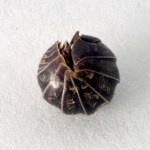
Pillbugs. Potato bugs. Rolly pollies. Don't we all remember these little innocuous guys? But did you know they could be zombified?!…
 jchosy |
Try this quiz. Pick out the titles of actual published scientific articles versus ones generated by a mad-libs-style algorithm....
Post your scores for bragging rights.
In case you need some cheering up after being squashed by this test of your mental acumen, check out these cuties at ZooBorns...
In this nightmarish time lapse video, a gentle spider crab is internally consumed by a terrifying angry red spider crab who then dispenses of the empty husk of its former host.
... or maybe its just molting
Thanks to our Asian friend Kangatron for sharing.
Stunning footage of deep-sea squids from the Monterey Bay Aquarium Research Institute (MBARI), where researchers use remotely operated vehicles (ROVs) to observe and record deep-sea animal behaviors.

Turns out casual experimention with a little meth here and there is a good thing, if you're a snail. A paper recently published in the Journal of Experimental Biology explains how snails were able to remember negative stimuli longer when under the influence of a bit of speed.
When great pond snails (Lymnaea stagnalis) venture into low oxygen water, they extend a breathing tube above the water's surface. Researchers seperated a bunch of these party snails into two groups and put one sober group in normal water and another in meth-laced water. Then when the snails went to extend their…
jchosy |
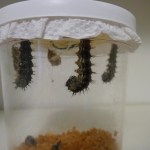
One chrysalis is bursting at the seams! This is what is about to happen...
The newly emerged butterfly will spend its first two hours pumping hemolymph into its wings. In this way, the soft, folded wings will straighten out and become more solid, more flight-ready.
 jchosy |
Since we last checked in, all 5 of our caterpillars made their transformation to chrysalis! Unfortunately, one of the Georges settled in too close to the side of the container. As he began to pupate, the forming chrysalis touched the plastic side, which must have been enough to cause a small tear in its surface. A few drops of liquid ran down the side, and the little guy stopped pupating. As I have come to find out, the caterpillar actually liquefies as it pupates. From this caterpillar soup, a butterfly will develop over 7 to 10 days. Except in George's case. RIP, George.
Here are a…
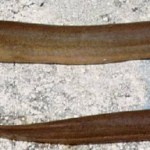
So a week back or so, a number of friends read an article about death by rectal eel and immediately thought of me. For those of you who missed the story, it went a little something like this:
* Chinese man gets drunk with friends and passes out
* Friends think it would be hilarious to insert a large living swamp eel into the man's butt while he is unconscious
* Hilarity does not ensue. In fact, the man dies. Chinese doctor says the eel "consumed the man's bowels"
The article was widely reported in major news outlets like CNN and the Times, but I am linking instead to the UK edition of…

Ann Littlewood is a one-time zoo keeper and now-time murder mystery writer whose stories take place in and around zoos. An awesome combination if you ask me. I'm very much looking forward to reading her upcoming book, Did Not Survive, but in the interim, I will wear my dog as a hat.
As you can see in this artfully composed camera phone pic, Ann provided me with a classic shot glass from the Oregon Coast Aquarium and Julia Goolia provided me a Louisville Zoo shot glass, bringing my total collection to... a lot:
Adventure Aquarium
Aquarium of the Bay
Baton Rouge Zoo
Birch Aquarium at Scripps…
 jchosy |
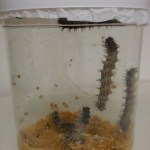
By DAY 7, the little guys aren't so little anymore...
Now that we can see some details on these guys, let's learn a little about what we're looking at.
Painted lady caterpillars have three pair of true legs, located closest to the mandible. The remaining five pair are called pro-legs or false legs. Although these 'false legs' are functional and important for the caterpillar for feeding, they get the diss because they are lost during metamorphosis. The butterfly emerges with only three pair of legs.
Each caterpillar has six pair of ocelli, or eyes. Even with all these eyes, their vision…
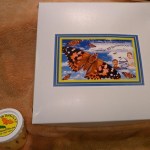 jchosy |
When you lose your job, you find yourself taking on new hobbies and projects. Some of them are productive. Some are fun. And some just satisfy the kid in you.
So, say hello to my painted lady caterpillars!
These cuties will be spending the next three weeks of their lives with me before being released into the flower-filled courtyard of my building, where they will hopefully get busy and help make more flowers during their short, 2-4 week lives.
I thought it would be fun, distracting, and great CV-fodder to take you all along with me. Aren't you lucky?! I'll keep you up-to-date on the…
 jchosy |
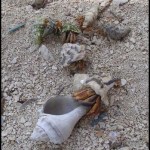
All my life I assumed hermit crabs deal with moving house the same way us humans do. When our living space gets a bit too cramped, we find a better-suited one, vacate the old one, and move. It's a fairly self-centered process and we rarely think about who ends up in our old space.
Well, I was wrong.
Biologists from Tufts University and the New England Aquarium recently published a paper in the journal, Behavioral Ecology, on the use of social networking by hermit crabs looking for new digs. They report that when a solitary hermit crab finds a housing upgrade, the overwhelming majority of…
Touching anthropomorphism or touching cannibalism? You tell me.
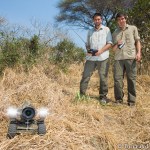
Leave your infrared-laser tripped stationary camera to your dad, the whitetail hunting enthusiast, 'cause you're about learn what REAL wildlife photography is.
Will & Matt Burrard-Lucas just wrapped up their first (largely) successful photography expedition using their ingenious BeetleCam, a remote control camera ATV. The brothers have been professional nature photographers since 2004 but really set themselves apart from the wildlife photography hive when they strapped their DSLR camera to four tiny all-terrain tires, and camouflaged it.
After poppin' some major wheelies in the airport…
 jchosy |
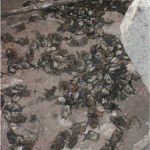
Following up on the previous white-nose syndrome blog, WNS has now been confirmed in Missouri. The article is about their monitoring program and does not mention the find, but our sources tell us there was recent PCR-confirmation of Geomyces destructans in samples taken from suspect bats in Missouri as part of this monitoring program.
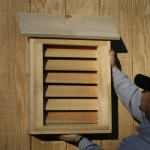
One way you can help save our bats is to look into getting a bat house. Bat Conservation International and the Organization for Bat Conservation both have great information about bat houses, and here is a wonderful homeowner's guide to bats.
Bat houses are…
 jchosy |
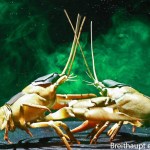
Researchers at the University of Hull, UK, recently published a paper about chemical signaling in reproductive behavior in crayfish. Yep, crayfish. Apparently, the female must release urinary cues in order to initiate courtship behavior in males. No pee, no sex. Unfortunately (and understandably), being peed on also triggers aggression in this species. The authors argue the female crayfish use their influential bodily fluids to stimulate aggression in males to gauge size and strength in prospective mates, allowing the females to choose the fittest males for subsequent copulation.
In male…
 jchosy |
I hate to get all serious, but this is a topic near-and-dear to me, and one that needs more publicity. And while Zooillogix readers are intelligent and well-informed (and smoking hot, I might add), I want to be sure everyone is aware of the progress and potential of this epidemic. Plus, I know I'm not the only batfan here.
In February of 2006, a caver in eastern New York photographed a group of hibernating bats with an unusual white substance on their muzzles. The following winter, bats were noted flying outside of caves months before they typically come out of hibernation. Then there…